Petite Tapisserie belongs to the Jumbo language
The 16202 Jumbo uses a Petite Tapisserie dial, preserving the finer visual scale associated with the historic Royal Oak. On replicas, a pattern that is too large immediately changes the perceived size of the dial and crowds the applied markers.
Grande Tapisserie suits the modern 41 mm Royal Oak
Current 15510 and 26240 references use Grande Tapisserie. The larger pattern should still have crisp edges, consistent depth and clean transitions at the date aperture or chronograph counters. Soft embossing or inconsistent square sizes can make the dial look cast rather than precisely formed.
Méga Tapisserie gives the Offshore its muscular scale
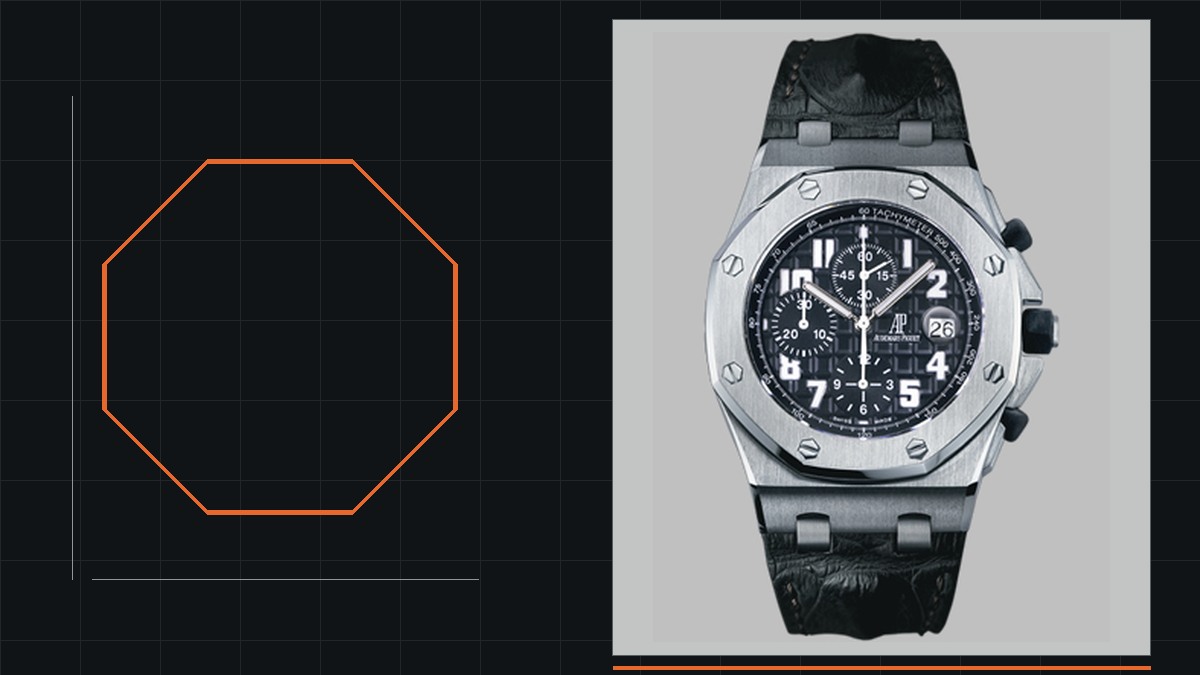
Royal Oak Offshore dials use the largest visual pattern. Because the counters cut through the grid, check whether the pattern terminates neatly around each subdial. Low-quality dials often lose definition at those boundaries.
Printing and applied furniture must sit on top of the grid cleanly
The AP logo, minute track, date window and applied markers should look deliberately placed relative to the pattern. Compare logo height, marker centering and the amount of pattern visible around the date aperture. Misalignment is easier to detect by counting pattern squares than by eyeballing the whole dial.
QC with a straight-on macro photograph
- Identify the correct pattern scale for the target reference.
- Count pattern rows between the center, logo and date aperture.
- Inspect pattern depth at subdial boundaries.
- Check applied-marker centering against the grid.
- Look for dust, uneven printing and inconsistent lume.
- Compare dial color under neutral light rather than saturated seller photos.
Pattern depth changes under different light
Photographs taken with direct frontal light can flatten the Tapisserie and make a weak pattern look acceptable. Side lighting produces small shadows around each square and reveals whether depth is consistent. Ask for at least one image with light crossing the dial diagonally.
Color matching is difficult because AP dials are not flat colors
Bleu Nuit and other AP dial tones interact with texture and finishing, so a single RGB comparison is not useful. Evaluate hue across several lighting conditions and focus on whether the replica color behaves naturally rather than whether one photograph matches an official marketing image.
Chronograph subdials interrupt the pattern
On Royal Oak and Offshore chronographs, the counter openings are a manufacturing stress point. Check whether the pattern ends cleanly at each subdial edge and whether the counters sit at the same depth. Uneven recesses can create shadows that make one counter look larger than another.
Pattern orientation should remain square to the dial
Even a crisp pattern can look wrong if the grid is slightly rotated relative to the case. Use the vertical line through 12 and 6 o’clock to check whether Tapisserie rows remain square. Misorientation becomes especially obvious around rectangular applied markers.
The pattern should not disappear under printing
On better dials, logos and scales are applied cleanly without paint filling the texture. Thick printing can bridge across grooves or soften the pattern underneath. Macro photographs of the AP signature and minute track can reveal whether the printing process respected the surface.
Sunburst and smoked effects are separate from Tapisserie quality
Some AP dials combine texture with gradients or changing color. A convincing gradient should transition smoothly and symmetrically. Do not let an attractive smoked effect distract from weak grid definition or crooked applied markers; color treatment and pattern execution should be judged independently.
Workshop test: use the pattern as a ruler
The Tapisserie grid creates its own measuring system. Count squares between the AP logo, center pinion, date aperture and markers. If those counts differ noticeably from reference images, the problem may be dial scale or component placement rather than simple photographic distortion. This method is particularly useful when exact millimeter measurements are unavailable.
Dial replacement can change the whole personality of a watch
Some replica owners upgrade dials later. Because Tapisserie scale, color and printing dominate the front view, a better dial can improve the watch dramatically—but only if it matches the case and movement. A dial designed for another generation can introduce date or marker misalignment even if its surface quality is superior.
Source notes
Technical specifications in this file are cross-checked against manufacturer material where available.