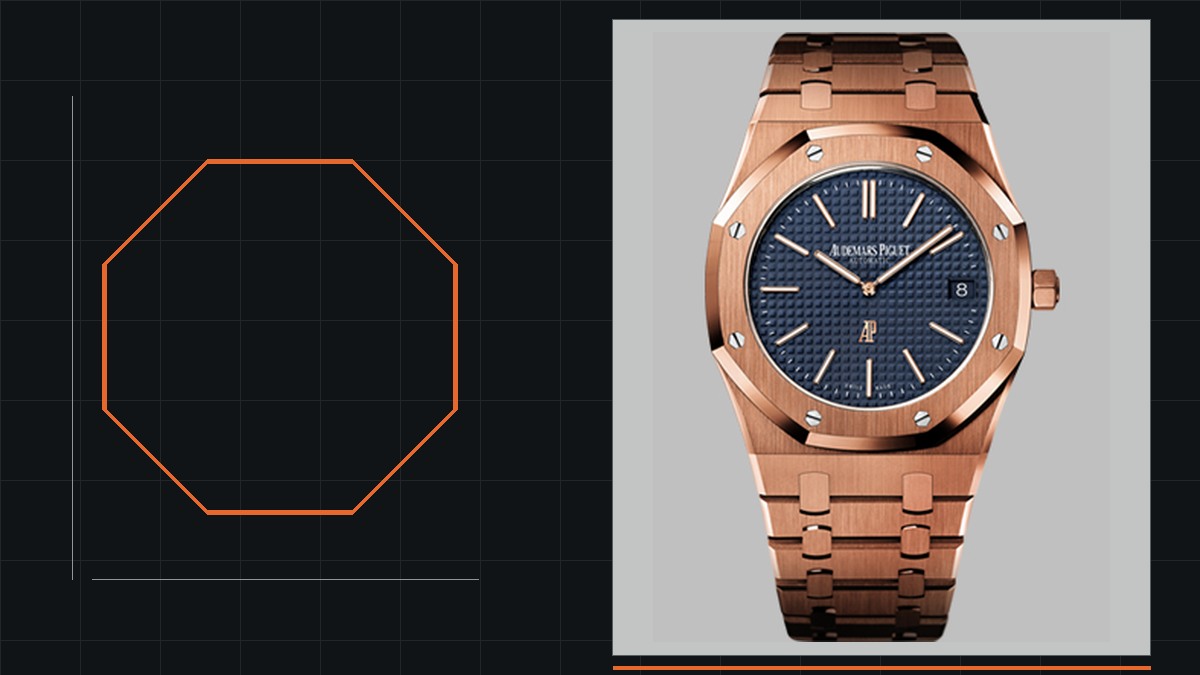
1972 is not background trivia
The Royal Oak changed the visual grammar of a luxury sports watch when it appeared in 1972. Gérald Genta’s design combined an exposed octagonal bezel, integrated bracelet, steel construction and a slim automatic movement in a form that was deliberately unlike conventional round dress watches. The historic 39 mm diameter is central to the “Jumbo” identity.
The old article on this URL preserved much of that story, including the 40th-anniversary period. Its English was damaged by machine translation, but the historical spine was worth keeping. The correct modern extension is the 16202 family, which maintains the 39 mm format and Petite Tapisserie dial while using a newer movement.
From Calibre 2121 to 7121
For decades the Royal Oak Jumbo was associated with the ultra-thin Calibre 2121. That movement became part of the watch’s mythology because it allowed a remarkably slim case. In the 16202 generation, AP replaced it with Calibre 7121, a modern selfwinding movement developed for the Jumbo format.
The modern 16202 still depends on proportion
The genuine 16202ST remains 39 mm and uses Calibre 7121. AP describes the steel model with its Bleu Nuit, Nuage 50 Petite Tapisserie dial as a tribute to the original 1972 Royal Oak. For a replica, the most important question is not whether the caseback engraving resembles 7121; it is whether the movement package permits the correct thin silhouette and dial geometry.
A tall automatic movement can force a thicker mid-case or raised caseback. Those compromises are visible from the side and can alter the first-link angle of the bracelet. Thinness therefore becomes a structural QC item, not a marketing adjective.
Petite Tapisserie changes the visual scale
The Jumbo uses Petite Tapisserie rather than the larger Grande pattern seen on many modern 41 mm Royal Oaks. A replica dial with the wrong pattern scale can look obviously incorrect even when the color is attractive. Compare the number of squares between the center pinion, logo and hour markers rather than judging texture from a compressed photograph.
Case and bracelet should read as one continuous object
On a Jumbo, the integrated bracelet is unusually important because the slim case offers little visual mass to hide an awkward transition. Check the polished bevel that runs from the case into the bracelet, the articulation of the first links and the taper toward the clasp.
QC for an Extra-Thin should include a side profile
- Compare total thickness and caseback projection.
- Confirm the dial uses a Petite-scale pattern appropriate to the 16202 target.
- Inspect bezel screw placement and recess depth.
- Check date-window centering and date-disc height.
- Look for continuous brushing and polished bevels across bracelet links.
- Photograph the watch hanging naturally to reveal first-link articulation.
The Jumbo is a proportion study, not a small Royal Oak
Reducing a 41 mm Royal Oak design to 39 mm is not enough. The Jumbo has its own dial scale, bezel relationship, bracelet width and vertical architecture. The flatter case and finer Tapisserie pattern make the watch visually calmer. Replicas that use a generic Royal Oak case often keep too much mid-case mass, producing a watch that reads like a compressed 41 mm model rather than a true Extra-Thin.
Movement replacement affects crown height
When a substitute movement is used, the stem axis may not align with the intended crown position. Manufacturers can compensate with case spacers or modified stems, but poor solutions leave the crown visibly too high or too low relative to the case band. This is easy to check in a perfectly side-on photograph.
The bracelet should fold almost like fabric
One attraction of the genuine integrated bracelet is the way many small links articulate around the wrist. A replica with thick link tolerances can look stiff and create flat segments instead of a continuous curve. Ask for a photograph of the watch wrapped around a small cushion or wrist; this reveals articulation better than a watch laid flat on a table.
Weight should not be used as a shortcut for material identity
The Jumbo’s compact size makes weight comparisons tempting, especially across steel and precious-metal-style replicas. But movement choice, solid or hollow links and caseback construction can change mass dramatically. Weight is useful only when the exact build specification is known; it cannot by itself prove steel grade or precious-metal content.
The date disc is especially visible on a simple dial
With no chronograph counters to distract the eye, date font and vertical centering stand out. Compare the height of single- and double-digit dates, the background color of the disc and the depth of the aperture. A mismatched white date wheel on a warm or blue dial can look more obvious than a small bezel error.
Decision note: do not sacrifice thinness for a more impressive-looking movement
For the Jumbo, case profile is central to the design. A taller movement with more elaborate decoration can force the watch away from the silhouette that made the 39 mm Royal Oak famous. A simpler, thinner and serviceable movement may produce a more convincing overall watch than a visually ambitious clone that adds unnecessary thickness.
Source notes
Technical specifications in this file are cross-checked against manufacturer material where available.